Energy
The Afourar hydroelectric complex
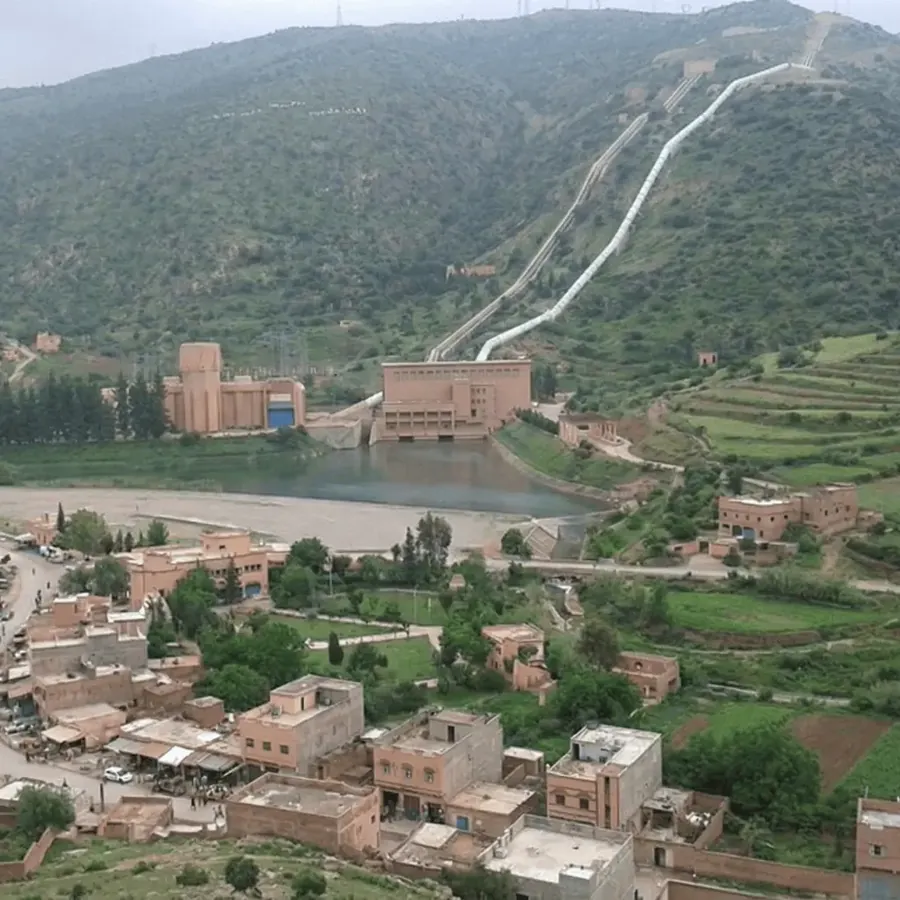
Morocco’s first pumped-storage station sits in the hills directly above the town: 465 megawatts of capacity, and an 800-metre drop.
The idea
A battery made of water and gravity
Electricity is difficult to store. A pumped-storage station sidesteps the problem by storing height instead. Two reservoirs are built at different altitudes and connected by a shaft. When the grid has surplus power — at night, or when solar and wind are producing more than the country is using — the machines run as pumps and push water uphill. When demand peaks, the same machines run in reverse as turbines and the water falls back down.
Round-trip efficiency is typically around 70–80%. Nothing is generated overall; what the station provides is timing — the ability to move energy by a few hours, and to respond to a change in demand within minutes rather than hours.
For a grid like Morocco’s, with rapidly growing solar and wind capacity, that flexibility is the point.
The numbers
Afourer STEP at a glance
Commissioned in 2004 and operated by ONEE, the Afourer station was the first pumped-storage plant in Morocco.
- Installed capacity
- 465 MW2 × 172.5 MW + 2 × 60 MW
- Machines
- ReversibleFrancis turbine-pumps
- Hydraulic head
- ≈800 mupper 1,280 m → lower 480 m
- Reservoirs
- 1.26 M m³each, purpose-built
- Commissioned
- 2004Morocco's first STEP
- Cost
- US$220 mArab Fund for Economic & Social Development
Where the water comes from
The station does not draw directly on the Bin El Ouidane reservoir. Its supply comes from the Aït Ouarda dam on the El Abid, a smaller structure downstream of Bin El Ouidane and about 9 km from Afourar, from which water is carried to the upper reservoir. Between the two Afourer reservoirs, the civil works required inclined shafts and roughly three kilometres of underground galleries.
What it does for the grid
465 MW is a meaningful share of Morocco’s peaking capacity, and the plant has been used as a balancing asset since it opened. It is one of two pumped-storage stations ONEE operates, alongside Abdelmoumen (about 350 MW) near Agadir, with further projects in the national pipeline as renewable capacity grows.
Separately, the Bin El Ouidane dam itself generates about 135 MW conventionally, so the El Abid system as a whole is a substantial piece of Moroccan electricity infrastructure — most of it within half an hour of Afourar.
Seeing it
What you can and cannot visit
The penstocks and the power house are plainly visible from the N25 as you climb out of Afourar towards Bin El Ouidane, and the view back down over the town and the plain from the first few switchbacks is the best short stop on the route.
The station itself is an operating industrial site, not a visitor attraction. There is no visitor centre and no public tour; the perimeter is fenced and photographing security infrastructure is not advisable anywhere in Morocco. Enjoy it from the road.
A good stop: pull in at one of the lay-bys on the first switchbacks above town, roughly 3–5 km along the N25 towards Bin El Ouidane. Late afternoon light on the plain is the reason the photograph at the top of this site exists.