Culture
Daily life and culture in Afourar
Two languages, two economies and one market day — plus the horsemen, the rugs and the quarter the dam engineers left behind.
Language & people
A town on a linguistic border
Afourar is where Darija, Moroccan Arabic, meets Tamazight. The plain to the north is historically Arabic-speaking; the mountains to the south are Amazigh. In the town both are ordinary, often in the same conversation, and most people under fifty move between them without thinking about it.
French is the language of administration and signage and is widely understood in shops and offices. English is much rarer — outside the lake hotels up the mountain, expect to get further with a few words of Darija and goodwill than with English.
Azilal Province is also known well beyond Morocco for its Azilal rugs: single-knot wool carpets on undyed backgrounds, with irregular, improvised drawing in bright dye. They are made in the villages of the province rather than in Afourar itself, but this is the road they travel down.
Market day
The weekly souk
One morning a week the town’s population roughly doubles and its economy reverts to something very old.
The souk is a regional institution rather than a local shop. Farmers come down from the Aït Attab hills and the higher valleys; traders come up from the plain and from Beni Mellal. Everything arrives before dawn, trading is busiest in the first few hours, and by early afternoon it is being packed away.
It runs every Sunday — the one morning of the week when the whole district comes to Afourar.
What is actually sold
- Livestock — sheep and goats above all, penned in a separate section, traded with the handshake-and-argument ritual that is the best free theatre in the province.
- Vegetables and fruit from the irrigated plain: onions, tomatoes, potatoes, melons in summer, mandarins and oranges in winter.
- Mountain produce — walnuts, almonds, honey, dried figs, wild herbs, wool.
- Olives and olive oil, at their peak from late autumn through winter.
- Everything else: mint and coriander by the armful, spices, tools, rope, plastic housewares, secondhand clothes, phone accessories, and men who will repair a shoe or sharpen a knife while you wait.
- Food on the spot — grilled meat, harira, bread, mint tea, usually the cheapest and best meal available that day.
Going as a visitor
Go early — by 8 am it is fully alive and by 2 pm it is over. Bring small notes; nothing takes a card. Ask before photographing people, and accept a no without argument. And if someone offers you tea, that is not a sales technique.
Festivals
Tbourida and the moussem
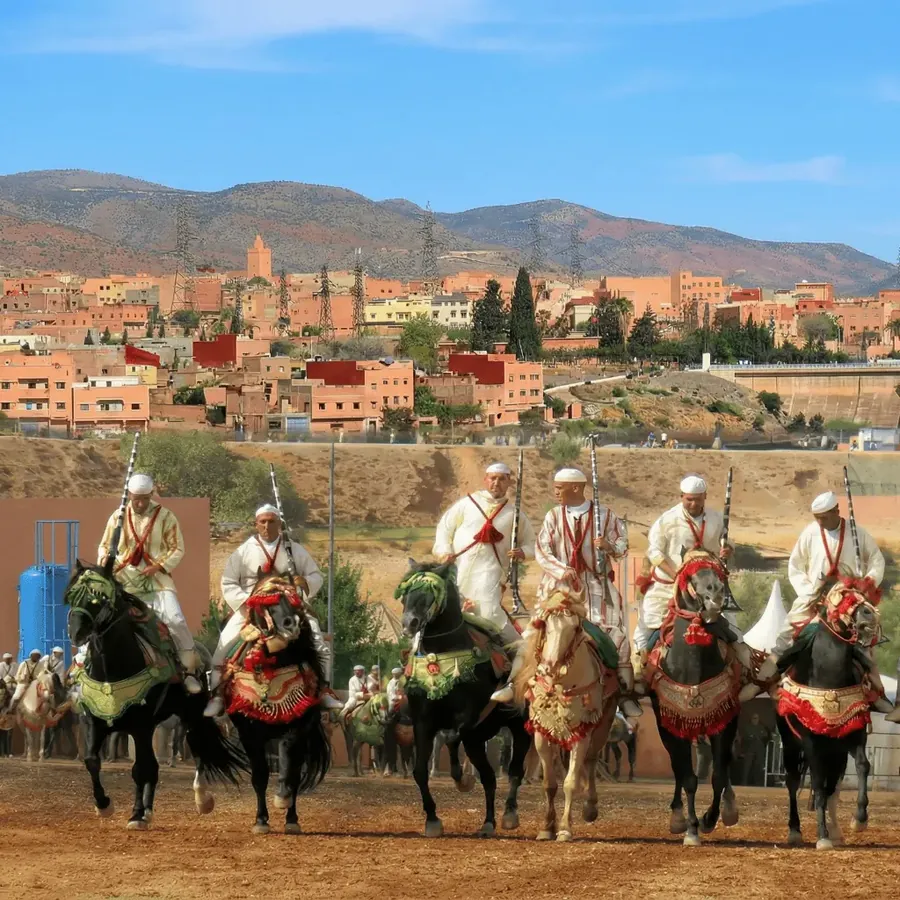
Tbourida — often called fantasia in French — is the equestrian display performed at moussems and public celebrations across Morocco, and it is taken seriously in this region. A sorba of fifteen or so riders lines up, charges the length of a field at full gallop, and fires their moukahla muskets in a single volley. The judging is not about speed: it is about whether the line stays perfectly abreast and whether the shots sound as one.
The horses are Barb and Arab-Barb, and their harness — embroidered saddles, tasselled breastplates, worked leather — represents a serious investment by the riders’ families. In 2021 tbourida was inscribed on UNESCO’s list of intangible cultural heritage.
Dates are local and vary year to year; a moussem is announced regionally rather than published on a calendar months ahead. If you are in the area in late spring or at harvest time, ask.
Built form
Two towns in one
Most of Afourar is ordinary contemporary Moroccan construction: concrete frames, ochre and pink render, flat roofs used as terraces, ground floors given over to shops. It is not picturesque and it is not trying to be.
Then there is the other quarter — low white villas with red-tiled roofs, deep gardens, mature trees, laid out on a plan dating from the dam works of the late 1940s. Walking from one into the other takes about four minutes and tells you most of the town’s twentieth century.
Above both, from almost anywhere in town, you can see the penstocks of the power station running down the mountain. Very few small towns have a skyline that explains themselves so efficiently.